Saturday, February 06, 2010

Opening of Perth International Arts Festival


Yesterday the Perth International Arts Festival opened in the Supreme Court Gardens in downtown Perth. The opening event started with Noongar elders welcoming audiences and artists from around the world. This ceremony included didgeridoo and dance performances.

The main event was an open air performance of La Fura Dels Baus, a Catalan theatre group. Jurriaan had seen them once over 20 years ago in Holland and was impressed. Since then they were most famous for a spectacular opening of the Olympic Games in Barcelona in 1992. So we had high expectations. Before the main performance started, safety announcements told us that we would have to stand and move during the performance. The performers walked right through he audience and took somebody right next to us, strapped him a 'fly suit', and hoisted him right above us.


Fly-man flying above us

In a later phase of the show, actors strapped to a giant treadmill descended from the sky. The treadmill was attached to a chariot. The climbing, walking and hanging actors in the treadmill push the chariot forward straight though he audience.


Treadmill moving through the audience

In the finale, performers in white suits were hoisted high above us. The movements with the backdrop of the evening sky, the light show and the fireworks made this a visual spectacle.


The finale with performers flying above us

Sunday, January 10, 2010

Windsurfing on Swan River


After lots of windsurfing at Moonbeach in Egypt, we have windsurfed surprisingly little since we live in Perth. Many of the beaches have too much surf for us to get comfortably in with water with board and sail. But Pelican Point is on the the shore of the Swan river close to our house and is a good windsurfing spot. Corine called the windsurf rental of Pelican point and organised a windsurf session for Sunday afternoon. Due to her pregnancy she can not surf right now, but she can make pictures of Jurriaan from shore.


Jurriaan preparing for a beach start

That afternoon turned out to be very windy (15 kts). After 1.5 year without practice we were wondering how Jurriaan would go. But nothing was forgotten and got in poistion for a beach start and just went.

Jurriaan surfing on a windy and choppy Swan River

The river is shallow and most of the time you can still feel the riverbed when you happen to end up in the water in stead of on the board. There are also lots of weeds in the water that can be awkward. There are lots of surfers on the water, and there is a good atmosphere. We will be back! We just need to buy a board...

Jurriaan on his way back to Pelican Point

Friday, January 01, 2010

Christmas in WA


This year we choose to have our Christmas holiday closer to home in Pemberton, Myalup and Perth. Corine is too pregnant to travel far.

In Pemberton (still somewhat far at 4hrs drive) we stayed in a lovely house on the shore of Donnely lake. Our house was well-equiped with a kayak for the lake, a spa on the veranda and a BBQ.


Live is good

The idea was to catch trout in the lake with our rented fishing gear and put that on the BBQ. We tried a couple of times, but we were happy that we always had a back-up meal in case they would not bite. They must have bitten sometimes as we lost bait from our hook, but these trout were very skilled in eating bait without getting hooked! So we ate sausages and kangaroo instead, which fitted nicely with the good local Pinot Noir.

Jurriaan trying to catch trout on Donnely Lake

The area around the house had lots of bird life, nice walking tracks and in the evening lots of kangaroos.

Kangaroos at sunset

We visited some of our favourite local wineries in the area. One winery let us taste straight from the barrel how they Chardonnay, Pinot Noir and Shiraz were developing. When these are released in bottle in a year or so we should be back. On our way back to our cottage we explored an easy offroad track to Lake Jasper, a natural lake filled by groundwater. The track continued to Black Point, one of only 2 places in West Australia where basalt rock comes to the surface. But the track became sandier and we were not prepared with offroad recovery gear, so we decided to head back. On the way back some of the easy track was now uphill. Uphill sand appears a lot softer than downhill, so we were forced to lower our tyre pressure to be able to drive back.

Corine driving Jansz over a river on the Lake Jasper track

The next day we were in for more serious offroad driving. Corine organised a tag-along tour in D'Entrecasteaux National park. A guide lead the way through the sand and we followed in our own car. The first serious dune and beach driving in Australia for us.

Pregnant Corine with our car Jansz on top of a white sand dune

We had a lot of fun, and the sand driving skills we picked up in Egypt came back quickly. For one dune ascent we needed to lower our tyre pressure a bit more than normal to make it. But our car, Jansz, performed very well.

Jansz on the beach of D'Entrecasteaux National Park


In Myalup, a beach town 1.5 hrs south of Perth, we spent the second part of our holiday. We stayed at a beach shack overlooking the Indian Ocean. A great location to watch the sunset. Christmas on the beach.

Pregnant Corine enjoying a mocktail on the veranda overlooking the ocean

It was also a good place for several water sports and national park exploration. Jurriaan recently bought a body board and practiced in the waves of Myalup beach. In Binningup, 10 km south, a small reef protects the beach from the surf, making it a good place to snorkel. We saw some nice angelfish.

Pregnant Corine in wetsuit after our snorkel

In Bunbury, a large town 40 km South, we had signed up for a dolphin snorkel tour. Unfortunately it was boxing day with many people out in their powerboats chasing the dolphins away. We saw a lot from a distance, but no snorkeling together this time.

Dolphins in front of our boat

The next morning we visited the Dolphin Discovery Centre again. We were lucky that a mother and calf visited the shore several times, swimming a metre or 2 away from us standing in the water!

Bunbury is also the second location (after Black point) where basalt come to the surface.

Pregnant Corine on the black basalt rock in Bunbury

The last days of our holiday including New Year's eve we spend at home in Perth, writing christmas cards and getting the babyroom ready. And we finally ate very nice rainbow trout from the fishmonger.

Monday, September 28, 2009

Long weekend at the Porongurups

The Porongurups are a small mountain range of granite formations of up to 670 metres, a 4 hours drive south-west of Perth. It’s peaks offer magnificent views of the Stirling Ranges on one side and the Southern Ocean on the other. During wildflower season, the Porongurup and Stirling Range National Parks are full of spectacular and unique wildflowers. Although only 20 km apart, both have a very different biodiversity. We rented a chalet as our base for hikes. Conveniently, there are some nice wineries dotted along the mountains. The Porongurup and Stirling Ranges were formed by 1.1 billion year old granite intrusions during the collision of the Antarctic and Australian continents forming the super continent Gondwana.

It was the first real spring weekend this year, with two consecutive days of solid sunshine. We drove past endless yellow fields of canola (“koolzaad”) plants in bloom.
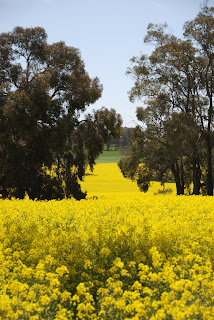
Canola Fields


In the Porongurups are many Marri trees. These trees can grow up to 60 metres tall and are unique to Western Australia. They are also commonly known as Red Gum trees not because of the colour of the wood, but because of the colour of the sap or gum. When the bark of the tree is injured, it seeps a red gum and looks as if it is bleeding.


Aboriginals used the red gum, or "kino" to sprinkle onto wounds to prevent bleeding or mixed with water as a mouthwash or disinfectant. The tannin has antiseptic qualities. Large quantities of the powdered gum was also used to tan kangaroo skins.


Red Gum Tree

In the Porongurups we walked the Nancy’s Peak Circuit, a beautiful ridge walk, passing 3 peaks. The first was Hayward Peak (610m), named after Seybert Hayward who was Western Australia’s first director of tourism (1921-1942). The views to the Stirling Ranges were beautiful. Then came Nancy's Peak (670m) with views both to the Stirling Ranges and the Southern Ocean and Albany.

View to the Stirling Ranges


The last peak was Morgan’s View (585m), named after Alfred Edward Morgan, Premier of Western Australia for one month during 1901. Morgan owned land to the south of the range.

After a late lunch at Jingalla winery, we drove to the eastern side of the Porongurups. Flower colours changed from many purple and yellows, to more reds.


We walked the Castle Rock Trail to Balancing Rock. Here we saw the Southern Cross flowers. The flowers resemble the Southern Cross constellation, a symbol of Australia.

Southern Cross flower

We reached a massive rock called, quite appropriately, Balancing Rock. Constant weathering of the Porongurup Range over millions of years has left the harder granites exposed as bare domes or gigantic perched boulders. Balancing Rock is 6.4 metre high and has a 16 metre girth. Estimated to weigh around 186 tonnes, it rests perfectly balanced on a 1.21 square metre base.

Corine balancing on Balancing Rock

A little further, we climbed Castle Rock (570m). This rock was found and named Alfred’s Castle by Alfred Meadows Gillam (1846-1930), who was the first European to have climbed this monolith. The construction of a ladder, walkway and viewing platform on Castle Rock enabled us to enjoy the magnificent vista. The ladder was reached by scrambling over some 2 metre boulders. As usual we saw the appropriate warning sign: “please take care – your safety is our concern but your responsibility”.
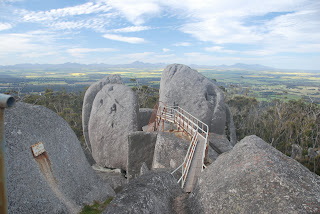
View from Castle Rock

Another flower we saw all over the Porongurups, was a particular blue flower. We saw these along the ridge and thought that half of each flower had been blown away by the strong winds. But as we saw this flower in the dense undergrowth of the tall trees, we realised that it is a flower supposed to look like this. It never had been a round flower, but always "half"...

We drove back through the Stirling Ranges on Monday, with dramatic clouds.

Both the Porongurup and Stirling Ranges are famous for their many species of orchids. At the beginning of our journey, we made a bet who would find the most species of orchids, however, we never got further than one, a cowslip orchid.

Cowslip orchid

Saturday, September 12, 2009

Wildflower festival in Kings Park

September is wildflower season in Western Australia, and the 400 ha Kings Park close to our house hosts the Wildflower Festival with guided tours through its botanical gardens and nature walks. Today started sunny so we went out to see what was flowering...


The south west of West Australia is Australia's only Global Biodiversity Hotspot and one of the twelve botanical hotspots in the world. Of the 25,000 plant species in Australia, 12,000 are in Western Australia. Nearly 80% of the plant species in the region are found nowhere else on earth.


Pink and white Everlasting flowers


We took a tour of the botanical garden. Our guide was very knowledgable not only about all the flowers, but also about the many different trees that we have here.

Our tour group under a beautiful peppermint tree

Most flowers in WA need birds rather than bees to transport pollen and germinate. There are some native bees in in Australia but they do not occur in swarms and honey was therefore not known in Australia until European bees were imported.

A bee germinating a Buttercup flower

Not surprisingly, there are also numerous birds in the park, sometimes easier to hear than to spot. We spotted many Red Wattle Birds this time around, who were feasting on the blooming flowers of the Parrot Bushes.

Blooming Parrot Bush flower

Red Wattle Bird

In Kings Park are 60 orchid species. This is more than can be found in the whole of Europe!

Pink Fairy Orchid

There are 76 Banksia species, and all but one occur naturally only in Australia. Banksias were named after Sir Joseph Banks, who, in 1770, was the first European to collect specimens of these plants. South western Australia contains the greatest diversity of banksias, with 60 species recorded.

Banksia

Many flowers have very different shapes and colours than what we are used to see in Europe.

Example of an atypical flower

Impressionist picture

Sunday, September 06, 2009

Birthday girl finally becomes pilot

For her last birthday Corine's present was a trial flight with the Royal Aero Club at Jandacot Airport. Today was the day that this dream became reality. Corine was assigned an intructor, Graham and a plane, a Cessna 152 single engine two-seater. Her plane was the VH-TNO: Tango-November-Oscar.
Corine and her Tango-November-Oscar

The plane was to take off in formation with a vintage orange Tiger Moth.

The orange Tiger Moth

And Corine would control the take off of her Tango-November-Oscar!

Corine in control

They would fly in formation to the coast, just south off Fremantle. The Tiger Moth would then split from the formation and each would go their own way.

...And we have lift off

on her way to the coast

Corine would fly along the coast to Fremantle, Cottesloe, Scarborough, and Hillary's Boat Club. and meet the Tiger Moth after an hour to land in formation. Unfortunatly Tango-November-Oscar just missed the Tiger Moth for the formation landing. Corine and Graham landed the plane safely a minute later, and they taxied to the Royal Aero Club platform.

the eagle has landed

That was an unforgetable experience, and it certainly put a smile on her face!

Smiling Corine and her instructor


In Dutch we would say: "Nog een keertje!"