The Porongurups are a small mountain range of granite formations of up to 670 metres, a 4 hours drive south-west of Perth. It’s peaks offer magnificent views of the Stirling Ranges on one side and the Southern Ocean on the other. During wildflower season, the Porongurup and Stirling Range National Parks are full of spectacular and unique wildflowers. Although only 20 km apart, both have a very different biodiversity. We rented a chalet as our base for hikes. Conveniently, there are some nice wineries dotted along the mountains. The Porongurup and Stirling Ranges were formed by 1.1 billion year old granite intrusions during the collision of the Antarctic and Australian continents forming the super continent Gondwana.
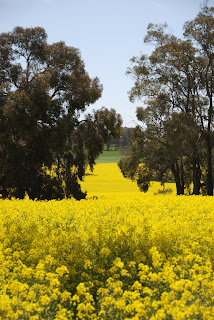
It was the first real spring weekend this year, with two consecutive days of solid sunshine. We drove past endless yellow fields of canola (“koolzaad”) plants in bloom.

In the Porongurups are many Marri trees. These trees can grow up to 60 metres tall and are unique to Western Australia. They are also commonly known as Red Gum trees not because of the colour of the wood, but because of the colour of the sap or gum. When the bark of the tree is injured, it seeps a red gum and looks as if it is bleeding.
Aboriginals used the red gum, or "kino" to sprinkle onto wounds to prevent bleeding or mixed with water as a mouthwash or disinfectant. The tannin has antiseptic qualities. Large quantities of the powdered gum was also used to tan kangaroo skins.
Red Gum Tree
In the Porongurups we walked the Nancy’s Peak Circuit, a beautiful ridge walk, passing 3 peaks. The first was Hayward Peak (610m), named after Seybert Hayward who was Western Australia’s first director of tourism (1921-1942). The views to the Stirling Ranges were beautiful. Then came Nancy's Peak (670m) with views both to the Stirling Ranges and the Southern Ocean and Albany.

View to the Stirling Ranges


The last peak was Morgan’s View (585m), named after Alfred Edward Morgan, Premier of Western Australia for one month during 1901. Morgan owned land to the south of the range.
After a late lunch at Jingalla winery, we drove to the eastern side of the Porongurups. Flower colours changed from many purple and yellows, to more reds.


We walked the Castle Rock Trail to Balancing Rock. Here we saw the Southern Cross flowers. The flowers resemble the Southern Cross constellation, a symbol of Australia.

Southern Cross flower
We reached a massive rock called, quite appropriately, Balancing Rock. Constant weathering of the Porongurup Range over millions of years has left the harder granites exposed as bare domes or gigantic perched boulders. Balancing Rock is 6.4 metre high and has a 16 metre girth. Estimated to weigh around 186 tonnes, it rests perfectly balanced on a 1.21 square metre base.

Corine balancing on Balancing Rock
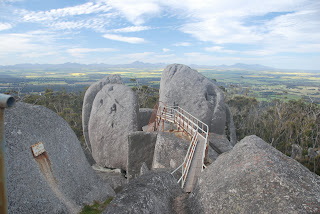
A little further, we climbed Castle Rock (570m). This rock was found and named Alfred’s Castle by Alfred Meadows Gillam (1846-1930), who was the first European to have climbed this monolith. The construction of a ladder, walkway and viewing platform on Castle Rock enabled us to enjoy the magnificent vista. The ladder was reached by scrambling over some 2 metre boulders. As usual we saw the appropriate warning sign: “please take care – your safety is our concern but your responsibility”.

Another flower we saw all over the Porongurups, was a particular blue flower. We saw these along the ridge and thought that half of each flower had been blown away by the strong winds. But as we saw this flower in the dense undergrowth of the tall trees, we realised that it is a flower supposed to look like this. It never had been a round flower, but always "half"...

We drove back through the Stirling Ranges on Monday, with dramatic clouds.

Both the Porongurup and Stirling Ranges are famous for their many species of orchids. At the beginning of our journey, we made a bet who would find the most species of orchids, however, we never got further than one, a cowslip orchid.

Cowslip orchid


 Posts
Posts